By Aadil Nathani
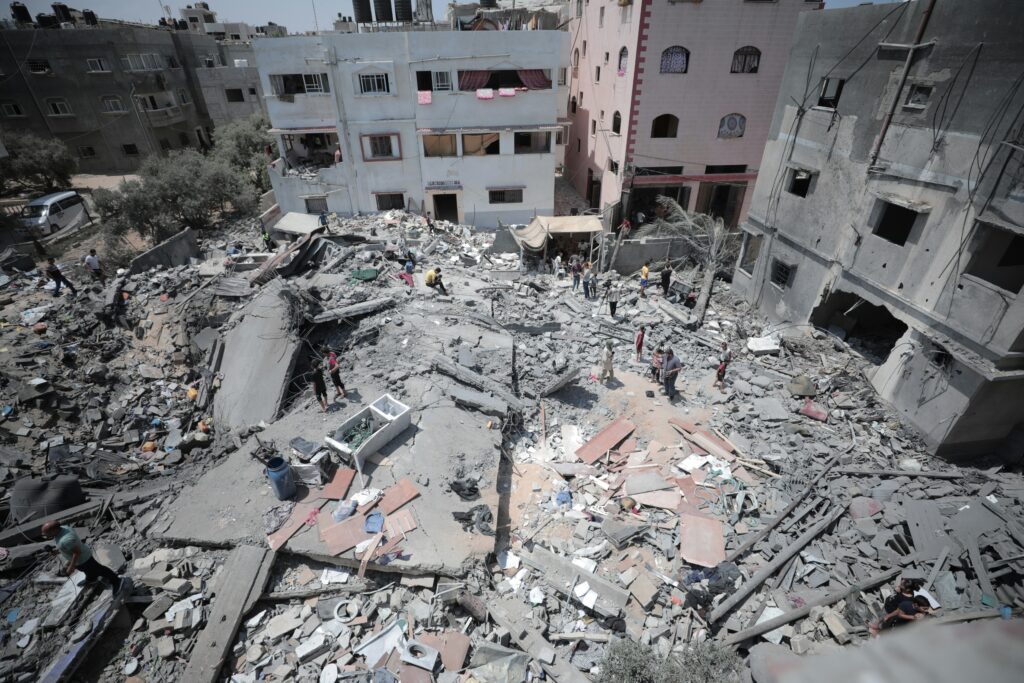
Indigenous peoples across the world have long maintained strong, reciprocal relationships with their lands and environments. In contrast, our resource-driven capitalist system has permitted, and in many cases encouraged, corporations to deforest, over-exploit, and deplete resources with minimal accountability. We see this in the deforestation of the Amazon and pollution of water sources in mining regions of South Africa and Ghana. We also see it unfolding in Israel’s war on the Gaza Strip. Since October 7, 2023, scenes of mass murder, mutilation, and displacement have played out daily across our social media feeds. The human cost is undeniable. Yet the impact on the land is often overlooked, despite its long-term consequences for generations to come. This scale of environmental damage, and the context in which it occurs, can constitute the basis for claims of ecocide.
The fight to recognize environmental destruction as a crime has been ongoing for over 50 years. In 2021, the Independent Expert Panel for the Legal Definition of Ecocide—a body comprised of international environmental and criminal law experts—defined ‘ecocide’ as:
“unlawful or wanton acts committed with knowledge that there is a substantial likelihood of severe and either widespread or long-term damage to the environment being caused by those acts.”1
The term ecocide was first used in reference to the United States’ deployment of toxic herbicide in Vietnam, the effects of which continue to contaminate rivers and soil today.2 Ecocide is currently recognized as a crime in 12 countries, and there are active efforts to expand its recognition. Pacific Island nations including Vanuatu, Fiji and Samoa are advocating for ecocide to be added as a crime under the Rome Statute of the International Criminal Court.
Ecocide is often the result of pollution, industrial disasters like oil spills and chemical run-off, and unsustainable resource extraction. It causes irreversible damage to the environment, human populations, and more-than-human life forms. There is also a direct and often underexplored link between war, forced displacement, genocide and ecocide. This piece aims to unpack that relationship using Gaza as a case study. It discusses ecocide through an Islamic lens and reflects on the ethical responsibilities we bear to avoid complicity in environmental destruction. This is not intended to minimize the devastating human toll or forced displacement in Gaza, but rather to how systems of genocide and ecocide intersect in the service of colonial agendas.
Israel’s Offensive in Gaza
Israel’s war in the densely populated Gaza Strip has been one of the most consequential and destructive conflicts of our time, one whose devastation is not limited to human life. The relentless bombardment has inflicted deep ecological harm and rendered large portions of the land uncultivable and uninhabitable. In June 2024, the United Nations Environmental Programme (UNEP) described the ecological toll of Israel’s assault as “unprecedented” and warned that the extent of damage to ecosystems and biodiversity may be irreversible.3
The UNEP’s Preliminary Assessment notes that “the bombardment of Gaza and resulting destruction of buildings, roads and other infrastructure has generated over 39 million tons of debris, some of which is contaminated with unexploded ordnance (UXOs), asbestos and other hazardous substances.”4 The level of destruction has caused immeasurable damage to the land’s viability, both now and for the foreseeable future.
Additionally, in the first two months of the war (October and November 2023), Israel’s airstrikes are estimated to have produced 281,000 metric tonnes of carbon dioxide.5 These emissions add not only to the devastation of Gaza’s environment, but also to the broader crisis of global climate change. In this sense, Israel’s war has contributed to accelerating the climate emergency at a planetary scale.
The direct impact on Gaza’s ecosystem, soil and agricultural capacity is also severe. According to UNEP’s February 2024 assessment, approximately 43% of all crops, 43% of orchards, 41% of irrigated cropland, and 42% of rainfed cropland have been destroyed. Additionally, between 44 and 52% of tree crops (up to 80% in Gaza City) were obliterated. Experts warn that this wide-scale ecological destruction will have long-term repercussions on food production and food security. The crops themselves have vanished, and the soil is now contaminated by heavy metals and other toxic substances.
Just as the environmental damage caused by the First and Second World Wars continues to affect ecosystems and food across Europe today, so too will the destruction of Gaza’s landscape impact future generations. The annihilation of olives, dates, and citrus crops (traditional staples cultivated by Indigenous Palestinians since time immemorial) undermines not only subsistence and economic survival but the core of Palestinian cultural identity. The loss of these crops, and the soil that sustained them, represents a form of environmental violence that disrupts livelihood and further entrenches displacement.
This environmental destruction has a direct impact on access to food and leads to malnutrition. Gazans are unable to produce their own food due to the destruction and are banned from fishing.6 The movement of goods and people in and out of Gaza is also controlled and restricted. In this context, the limited delivery of international aid is the only food source. As a result, by August 2025, at least 147 deaths caused by hunger and malnutrition have been reported, including 88 children, according to the United Nations. Additionally, the World Health Organization has recorded over 28,000 cases of severe acute malnutrition among children.7 In late July 2025, the United Nations-backed Integrated Food Security Phase Classification warned that the “worst-case scenario of famine is currently playing out in the Gaza Strip.”8 Famine is not a natural occurrence. One of the factors causing this specific famine is the mass destruction of native crops and degradation of the soil.
This does not capture the full extent of environmental harm caused by Israel’s war since October 7, 2023. Other critical aspects—including the depletion and contamination of water sources, destruction of wastewater infrastructure, the toxicity of decomposing human remains, and the alleged dumping of nuclear waste (both preceding and during the war)—remain outside the scope of this piece.
What Can We Do?
It is our responsibility to urge the Canadian government to take meaningful action to protect the environment, both at home and abroad. One avenue is to call for a reassessment of Canada’s trade partnerships, specifically those involving the export of arms, munitions and other wartime supplies, as well as government subsidies and investments in such industries. These decisions must be subject to a rigorous environmental review. We propose the application of a ‘green assessment’ or ‘green-screen’ to all government policies, programs and future legislation.
Just as the Canadian government currently employs a gender-based analysis plus (GBA+) to assess whether policies may negatively impact equity and inclusion, we advocate for a parallel environmental analysis. If implemented effectively, this ‘green-screen’ would ensure that Canadian products, and taxpayer dollars, are not contributing to environmental destruction or acts of ecocide. Furthermore, it is imperative that we continue to pressure the Canadian government to support international efforts to formally recognize ecocide as a crime under the Rome Statute, thereby enabling prosecution through the International Criminal Court.
French lawyer and ecocide advocate Valérie Cabanes, a signatory to the 2021 proposal to define ecocide in international law, powerfully observes: “by destroying the ecosystems on which we depend, we are destroying the foundations of our civilization and mortgaging the living conditions of all future generations.” She asks, “as well as being a major issue of global socio-environmental justice, is it not ultimately the survival of the human species that is at stake?”9
Ecocide may begin within national borders, but the consequences of climate change and environmental degradation are global. A bomb dropped in Gaza may release emissions that harm our children in Canada years from now. An olive grove set ablaze may spark a crisis in regional biodiversity. But whether we are directly impacted or not, we are morally obligated to stand for what is just.
War is an egregious form of human harm, but it is also a devastating source of environmental destruction. The devastation of one often perpetuates and magnifies the harm of the other. As Muslims, we are called to be stewards of the Earth. This requires us to advocate not only for human rights, but also for environmental justice, as part of our collective struggle to uphold the dignity of creation and preserve the integrity of the land.
- Legal definition of ecocide drafted by independent expert panel (no date) Stop Ecocide International. Available at: https://www.stopecocide.earth/legal-definition.
↩︎ - Gill, J. and Enahoro, N.A. (2024) Ecocide: Should destroying nature be an international crime?: Context by TRF, Context. Available at: https://www.context.news/nature/ecocide-should-destroying-nature-be-an-international-crime.
↩︎ - (2024) Environmental impact of the conflict in Gaza: Preliminary assessment of environmental impacts | UNEP – UN Environment Programme. Available at: https://www.unep.org/resources/report/environmental-impact-conflict-gaza-preliminary-assessment-environmental-impacts.
↩︎ - Ibid ↩︎
- Emissions from Israel’s war in Gaza have ‘immense’ effect on climate catastrophe (2024) The Guardian. Available at: https://www.theguardian.com/world/2024/jan/09/emissions-gaza-israel-hamas-war-climate-change.
↩︎ - Building to starvation: Systematic attacks on fishing in Gaza and implications for livelihoods and protection (2025) United Nations. Available at: https://www.un.org/unispal/document/building-to-starvation-systematic-attacks-on-fishing-in-gaza-and-implications-for-livelihoods-and-protection-may-2025/.
↩︎ - Hunger in Gaza: Women and Children Face Death in search of food | UN news (no date) United Nations. Available at: https://news.un.org/en/story/2025/08/1165575.
↩︎ - IPC Alert: Worst-case scenario of famine unfolding in the Gaza Strip (no date) IPC Portal. Available at: https://www.ipcinfo.org/ipcinfo-website/countries-in-focus-archive/issue-133/en/.
↩︎ - What is ecocide and which countries recognize it in law? (2021) World Economic Forum. Available at: https://www.weforum.org/stories/2021/08/ecocide-environmental-harm-international-crime/.
↩︎
Aadil is a lawyer in Toronto and is active with various non-profits and community organizing efforts. Aadil Nathani is the co-founder and a Board of Director of Green Ummah, a member of the Green Ummah Blog Editorial Team and he also sits on the Board of Directors for the Muslim Advisory Council of Canada.